The Perils of Despair: Why We Must Stop “Fetishizing” Our Great Friends to the North
Canada is amazing, but America is the only home we have

Those who have watched Hulu’s The Handmaid’s Tale will recall the harrowing opening scene: An American family is seen driving frantically through Maine, to the chaotic background noise of deafening sirens. Their goal was to cross the border to the north to seek asylum. But their car swerves from the icy road and hits a tree. In panic, the husband tells his wife to run away with their daughter on foot. Not long after, the husband is shot, and the wife and daughter are intercepted, and forcibly separated, by military members patrolling the border. They were not, however, agents of the US Customs and Border Patrol, nor were they agents of the Canadian Border Service Agency, but men in black uniforms cracking down on anyone attempting to cross the border.

What had happened was that a group of far-right extremists overthrew the US government and installed a totalitarian regime named “Gilead.” They suspended the Constitution, imposed martial law, and took control of every aspect of society. In response, many attempted to flee to Canada, but with minimal success. Those who managed to reach Canada, as the show portrays, are depicted as distraught refugees, given warm welcome, welfare assistance, and free counseling.
But Life Doesn’t Always Imitate Art
While the depiction of Canada’s welcoming of refugees in the Handmaid’s Tale is true-to-form, the contrast between the two countries in that show leaves a beguiling and deceptive impression of reality.
Given our current state of affairs, some of those who have watched the show might think that the United States will become Gilead (“Literally The Handmaid’s Tale!”), and that Canada will statically and unaffectedly remain a liberal utopia. Both impressions are dangerously naive and counterproductive.
“When America Sneezes, The World Catches a Cold.” And Canada Is Not Immune
One of the most influential roles of the United States in global affairs is that it determines, directly or indirectly, how other countries will be. In a way, the US’s state of affairs trickles down to other countries. When America thrives, so does the rest of the world. When America faces a deep financial crisis, the global economy suffers. Our current state of affairs is no exception.
While the rightward shift in global politics preceded the election of President Donald Trump, his election exacerbated it. Before we knew it, European countries were electing far-right officials to their government in huge numbers, anti-democratic superpowers, namely Russia and China, extended their hold and asserted their influence on other countries, and illiberal, human rights-abusing Islamic governments, such as Saudi Arabia, felt emboldened by the ascendant US isolationism, seeing it as a green light to pursue their draconian and barbaric policies, unhindered by Western interference or excoriation.
The effects of our current affairs on other countries vary from one to another, and Canada is an exceptional, and multifarious, case.
Ontario, Canada’s most populous province, has always been seen as a beacon of progressivism. Indeed, the Ontario government was the first English-speaking government entity in the world to legalize same-sex marriage — in 2002.
So it was shocking that, in 2010, Toronto elected the late Rob Ford, a scandal-ridden Conservative, notorious for his indulgent predilection for crack cocaine, as the mayor of Ontario’s capital and Canada’s largest city.

And in 2018, Rob Ford’s brother, Doug, was elected Premier of Ontario. (A “premier” is the Canadian equivalent of a “governor.”) He ran as a populist, conservative, “anti-elite” candidate, and was elected to become the leader of nearly 40% of the Canadian population. He is supported by prominent far-right figures in Canada, such Lauren Southern, an alt-right darling figure who shot flair guns at refugee boats in on European shores, and Faith Goldy, a white nationalist who herself is running for mayor of Toronto.
The Canadian Electoral System Is Slated Toward Conservatives
If the US electoral system, namely the Electoral College, is biased in favor conservative presidential nominees, then Canada’s “first-past-the-post” all but guarantees a conservative victory. The way Canadian federal elections work is that every riding, or seat (the Canadian equivalent of a “congressional district”) elects a representative of a certain party to the Parliament, and the leader of party that wins the highest number of seats becomes the Prime Minister.
There are three major parties in Canada: the Conservative Party (center-right), the Liberal Party (center-left), and the New Democratic Party, or NDP (left). (There’s also the Bloc Québécois, a Quebec nationalist and separatist party, but they seldom make any significant gains outside Quebec.)
In 2011, the Conservative Party won 166 seats (out of 308). The NDP won 103 seats, and the Liberal Party won 34. The remaining seats were won by smaller parties. Also, 5,832,401 voted for Conservatives, 4,508,474 voted for the NDP, and 2,783,175 voted for the Liberal Party.
In other words, most Canadian voters are left-leaning. But there are two left-wing parties that sometimes compete against each other, giving rise to the Conservative Party to win most seats.
While the Liberal Party has, indeed, won the 2015 election, and appointed Justin Trudeau as Prime Minister, right-wing populism, coupled with Trudeau’s waning popularity and the rise, and election, of right-wing populists like Doug Ford in Ontario, all but show that our friends to the north are not immune to Trumpism. Our state of affairs seem to have spilled over the border.
Liberal Americans Have a Card Up Their Sleeves: Their Love for America
What many Republicans seem to underestimate is how their fellow moderate and liberal compatriots love America
Democrats, like Republicans and Independents, love America beyond words. They stick by their country through thick and thin. Bush’s presidency did not change that, nor has Trump’s. If anything, the latter only made them love their country more, and fight tooth and nail for the only home they have.
Indeed, despite the efforts of certain right-wing elements in American politics, America remains the most welcoming and generous nation in the world. The US takes in more refugees and asylum seekers than all other countries combined. And even despite what some far-right pundits attempt to do, Americans protect those who make it to their shores.
They know that, if things fall apart, other countries will not be as accepting of American refugees as America has been of other countries’ refugees. Every other country will close their door on us. Americans love their country beyond words. Liberal Americans are no exception. When Trump was elected, Americans who opposed him didn’t pack up and leave; they stayed put, rolled up their sleeves, and worked hard to stand up for the only country they know, and the only home they’ll ever have.
Sweet Home Alabama, Sweet Home America
One does not have to look beyond Alabama to see how devoted Americans are to their country.
When the Senate seat in Alabama, one of the most conservative states in the country, was up for a special election in December 2017, Democrats seized on that opportunity. With all odds against them, Democrats began an uphill battle to win that one precious Senate seat. (For those unfamiliar with US politics, the United States Senate is the most powerful legislative chamber in the world. Not only does the US Senate make life-changing decisions for Americans, including the confirmation of the President’s cabinet and lifetime Supreme Court justices, but it also determines the course of American foreign policy, from confirming US ambassadors to international treaties.)
Democrats moved heaven and earth to get the Democratic candidate, Doug Jones, elected against the populist, pro-Trump candidate Roy Moore. They flew in from all over the country to campaign for Jones, and convince Alabamians to elect him. Major Alabama newspapers endorsed Doug Jones.
For all intents and purposes, the Alabama Senate seat was a shoo-in for Republicans. Once occupied by Jeff Sessions, a man who ran unopposed in 2014 and won 97% of the votes, only later to be nominated by President Trump as Attorney General, any other GOP candidate was sure to win. Given the political climate in the country, and Trump’s landslide victory in Alabama, the GOP was banking on a victory that was all but guaranteed.
But then a miracle happened.
As the country was shifting rightward, the conservative Heart of Dixie state took a left turn. Indeed, Alabama elected Doug Jones, a pro-choice liberal Democrat, in an election that not only shocked the world, but also served as a testament to the will of the American people. Not only did African-Americans come out in large numbers, but also many conservatives have crossed the party line to vote for Doug Jones.
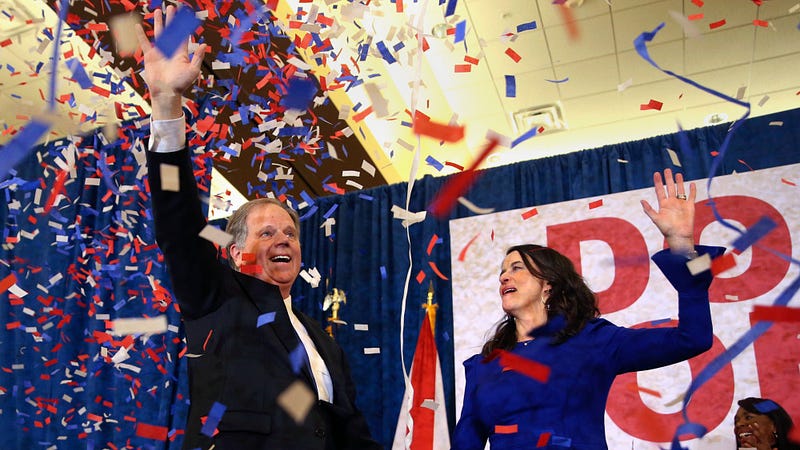
A victory for Democrats in deep-red Alabama is an example that, even against all odds, Democrats can still win. And even a greater examples that Democrats, from Maine to Hawaii, will fight tooth and nail for their country.
The Secret to America’s Survival Is The American People
To the outsider, and indeed among us in the United States, America appears fractured, tribalistic, and divided. And, to a great degree, it is.
But America isn’t “liberal” or “conservative.” Each side displays their love for country in their own way.
Conservative Americans, for example, are, by and large, pro-gun, pro-limited government, and pro-military. Many served in the military themselves, and while they love their country, they have also always looked at the federal government with suspicion, and continue to do so. After all, the United States was founded on personal freedom from tyranny and an overreaching government. It is this mentality that allowed freedom of expression, and America itself, to thrive.
Liberals seem to prefer a more robust system: a government-funded healthcare, public education, and firearm safety measures. But beyond that, liberals are not a monolith; indeed, many liberals serve, or have served, in the military, a significant number of them are gun owners, and they are, overwhelmingly, patriotic.
The relation between liberals and conservatives in America has not always been adversarial. On the contrary, it has always been symbiotic. Both liberals and conservatives in America have more in common than what divides them. Despite the powers that be, from politicians to pundits, that attempt to stoke discord between “the left” and “the right,” both sides love their country — in their own way.
Paradigm Shift?
It’s easy to succumb to desperation and believe that things will never change here at home. But America is not beyond redemption, and Canada is not immune to right-wing populism. Canada has been a staunch ally and a loyal friend to the United States (despite President Trump’s deference towards illiberal dictators over Western allies). And while Canada has a unique culture, even when it comes to language, it is still influenced by the events and “trends” in the US. Right-wing populism is no exception. The most recent election in Ontario serves as a testament to that.
The next federal elections in Canada will take place in a few months — October 21, 2019, to be exact. Either right-wing populism will reverberate across the country, or the warnings about such outcome will be mocked as an alarmist exaggeration. For the sake of Canada — and the United States — one would hope it’s the latter.